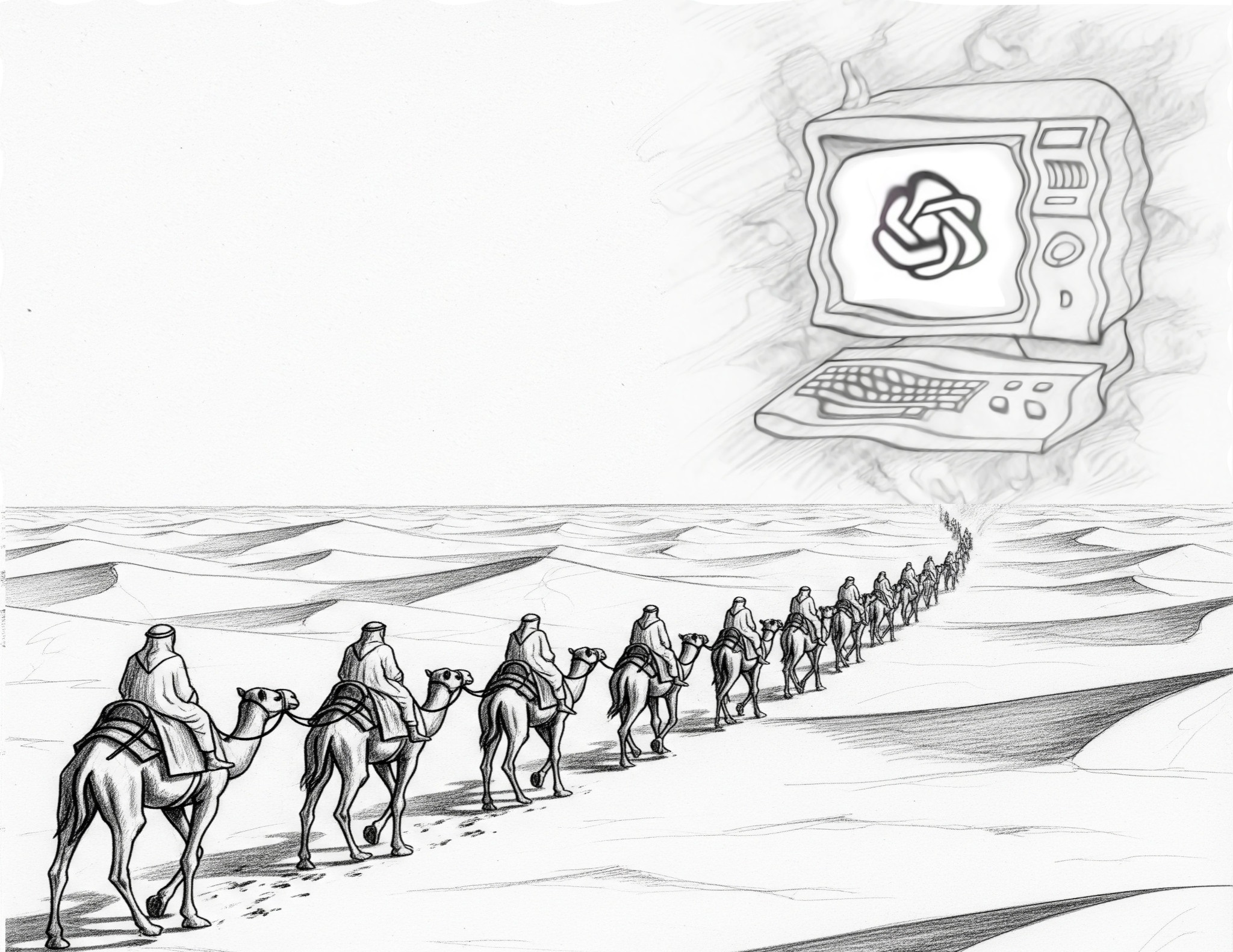
Today, we’re increasingly encountering the term “cognitive mirage,” particularly in scientific articles on artificial intelligence. Most often, this concept is used to describe the phenomenon of so-called hallucinations in large language models (LLMs). These models, built to mimic the workings of the human brain, sometimes generate incredibly convincing yet entirely fabricated responses. Recent scientific reviews have even introduced special terms and benchmarks to describe this effect. For example, in the paper “Cognitive Mirage: A Review of Hallucinations in Large Language Models” (2023), researchers systematize instances where LLMs form false judgments and answers. This year also saw the introduction of a specialized set of tests for measuring the level of these distortions—the MIRAGE-Bench. All of these developments reflect a shared concern: a machine can speak confidently, but not always truthfully.
Yet, the phenomenon itself isn’t a digital-age invention. Cognitive mirages have accompanied humanity throughout history. As far back as ancient Greece, the philosopher Plato, in his Allegory of the Cave, described a situation where people perceive shadows on a wall as true reality. This is, in fact, one of the first descriptions of a cognitive mirage: when imagination or limited experience creates an illusion of truth. Two thousand years later, the French mathematician and thinker René Descartes questioned the very reliability of human senses. He asked himself: how do we know we aren’t dreaming when we are certain we are awake? In these reflections, we see the same intuition again: our mind can create pictures of the world that are, in reality, false.
Human history is filled with countless examples of such mirages. One of the most famous was Ptolemy’s geocentrism. For over a millennium, this model of the world seemed unshakeable and “obvious”: the Sun, Moon, and stars appeared to genuinely revolve around the Earth. It was only Copernicus, Galileo, and Kepler who shattered this grand mirage by proving heliocentrism. Another example is alchemy. For centuries, people believed it was possible to turn base metals into gold or discover the “philosopher’s stone.” Alchemy became a kind of illusion of scientific knowledge, which, while it spurred the development of chemistry, turned out to be a flawed picture of the world itself.
A lack of information was often the cause of new cognitive mirages. In the 19th century, a widespread belief was Lamarckism—the idea that acquired traits could be passed down. This theory seemed convincing because knowledge of genes was lacking. It was only later, with Mendel’s discoveries and the development of genetics, that this scientific mirage was debunked. Similarly, in the early 20th century, eugenics became popular—the certainty that humanity could be “improved” through selective breeding. This illusory narrative, which seemed scientifically sound, led to tragic consequences and was finally discredited after World War II.
In a cultural sense, cognitive mirages appeared in the form of utopias and dystopias. Utopian theories, from Thomas More’s Utopia to the communist ideals of the 20th century, were built on convincing but often reality-detached images of a perfect society. Dystopias, in turn, revealed the destructive consequences of these illusions: Orwell and Huxley showed how the pursuit of an ideal could turn into a trap. And here, too, the mechanism of the cognitive mirage is at work: people see a picture of the future as the only correct one, without realizing its falsity or danger.
The cognitive mirage has much in common with a number of phenomena long described in psychology. For example, confabulation is a situation where memory fills in gaps with fabricated details that seem true to the person. Illusions of perception are also well-known, such as the Müller-Lyer illusion, where we see two identical lines as different in length. The British psychologist Richard Gregory described perception as a hypothesis: our brain always fills in missing information. In all these cases, the mechanism is similar: the mind strives to create a coherent and convincing picture, even if the data is incomplete.
Modern information technologies have accelerated and complicated this process. In a world of data overload, cognitive mirages arise not just from a lack of knowledge, but also from its excess. On social media, users often mistake their information bubbles for the complete picture of reality. In economics, we see “startup mirages”—when investors pour money into projects without real substance because they are convinced of their success. In politics, propaganda systematically creates cognitive mirages by manipulating facts and forming illusory narratives that influence public consciousness.
In this sense, large language models are merely following a path similar to humans. They, too, create illusions of knowledge, seeking to weave disparate data into a single story. Therefore, the concept of a “cognitive mirage” becomes a kind of bridge between the nature of human thought and the work of artificial intelligence. In both cases, the illusion often appears more plausible than reality itself.
The task of modern science and culture is not so much to completely avoid cognitive mirages—since they are inevitable—as it is to learn to recognize them in time. Only by being aware of the limits of our own knowledge can we distinguish between truth and illusion. And it is in this ability to differentiate a mirage from reality that the main challenge lies for both humans and artificial intelligence in the 21st century.