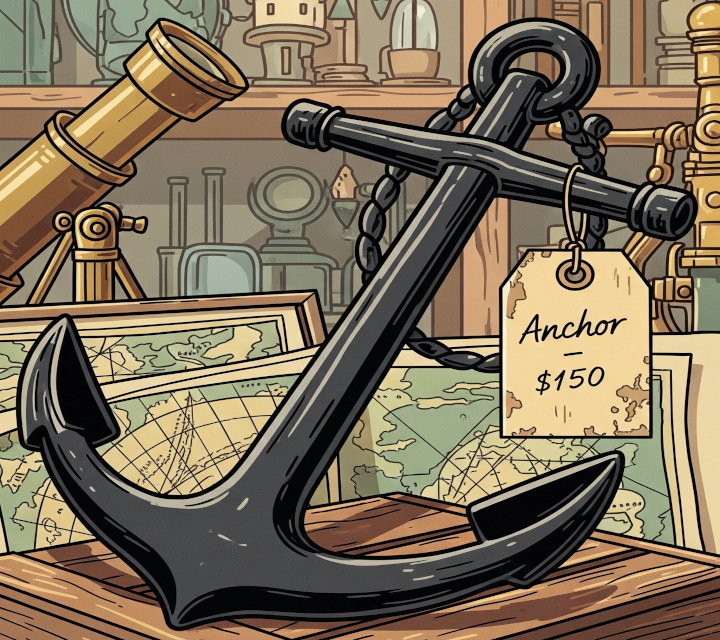
The anchoring effect in pricing is a behavioral phenomenon in economics and marketing in which the initial price offered to a buyer influences his or her perception of the value of a product or service and subsequent purchasing decisions. This effect is based on a cognitive bias, where people tend to rely on the first piece of information they receive (anchor) when evaluating subsequent information, even if the information is unrelated. In pricing, an anchor price forms a consumer’s perception of a “reasonable” or “acceptable” price, which can be used to manipulate demand.
The anchoring effect is widely used in retail. For example, a store might list a TV for $2,000 and then list a “discounted” price of $1,500 next to it. The initial price ($2,000) acts as an anchor, making the discounted price seem more attractive, even though the actual market value of the TV may be much lower. This approach makes consumers perceive the discount as attractive, even if they did not plan to spend that much.
This phenomenon has its roots in behavioral economics, particularly in the work of Daniel Kahneman and Amos Tversky, who studied cognitive biases. Their experiments showed that people tend to give excessive weight to the first information they receive. In the context of pricing, this means that an anchor price can affect not only the perception of the value of a product, but also the willingness of consumers to pay more than they planned if the anchor seems “reasonable.”
The anchor pricing effect manifests itself in various areas. For example, in restaurants, menus often include an expensive dish (anchor) that makes other lower-priced dishes more attractive. Similarly, in e-commerce, companies may offer “premium” packages with a high price to make standard packages seem economically advantageous. Research shows that anchor pricing is effective even when it is arbitrary or unrealistic, as consumers rarely conduct in-depth analysis of market prices.
A distinctive feature of the effect is its context-specificity. For example, in high-income countries, anchor prices may be higher, while in regions with lower purchasing power, sellers use lower anchors to achieve the same effect. Furthermore, the effect may be weakened if the consumer has significant experience or knowledge of market prices, which allows them to ignore the anchor.
The anchor pricing effect has both positive and negative consequences. For businesses, it is a powerful tool for increasing sales and margins because it allows them to manipulate perceptions of value. However, abuse of high anchor prices can lead to a loss of trust among consumers if they discover that the prices are artificially inflated. For example, in 2018, a number of retailers in the United States faced criticism for using fictitious “original” prices that were never used in practice.
This phenomenon also has implications for market regulation. In some countries, such as the European Union, regulators require companies to justify discounts to prevent manipulation of anchor prices. This is designed to protect consumers from misleading marketing practices. At the same time, the anchor pricing effect remains popular in marketing due to its simplicity and effectiveness.
The anchor pricing effect illustrates how psychological aspects influence economic decisions. Understanding it allows both businesses and consumers to better navigate market strategies. For companies, it is a tool for optimizing pricing policies, and for consumers, a reminder of the need to critically evaluate offers. In today’s economy, where information plays a key role, this effect continues to shape the behavior of both sellers and buyers.